
TOOLBOX TALK: Night Vision
RATTLIR SAFETY SERIES - "STRIKE BEFORE IT BITES"
Purpose
Night operations present unique visual, physiological, and operational challenges for sUAS crews. Reduced visibility, loss of depth perception, interference from artificial lighting, and changes in human visual processing require pilots and visual observers (VOs) to implement enhanced scanning, communication, and hazard recognition techniques. This toolbox talk combines FAA night requirements, human vision science, and RATTLIR industrial flight hazards to ensure safe and reliable nighttime operations.
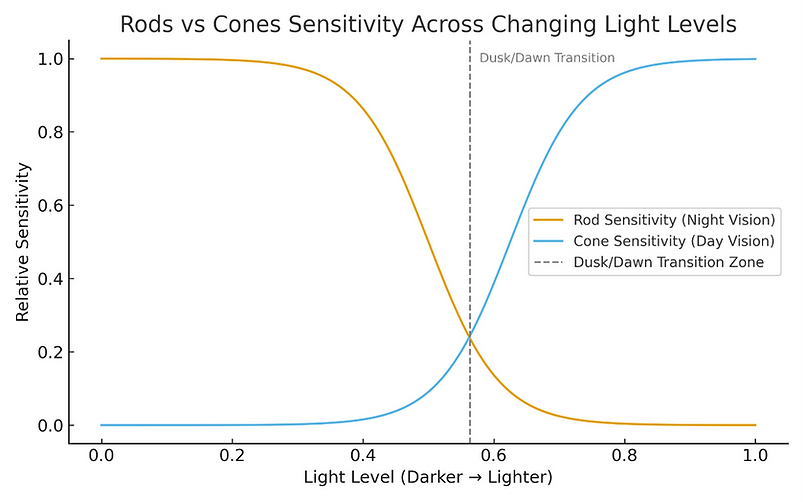
Figure 1 - Rods vs Cone Sensitivity Across Light Levels
FAA Requirements for Night Operations
Night flights under FAA Part 107 require enhanced aircraft lighting and increased crew situational awareness:
-
Anti-collision lighting must be visible for at least 3 statute miles.
-
Pilots must understand the reduction in visual performance after sunset and during civil twilight.
-
Night operations require the ability to identify obstacles and aircraft orientation visually.
-
Remote Pilot in Command (RPIC) must verify that all crew can maintain effective scanning in low light.
Human Eye Anatomy and Night Vision (Rods and Cones)
Night vision depends heavily on the behavior of rods and cones, which function differently under low-light conditions:
-
Cones, located in the fovea (center of vision), require bright light and provide color and detail. They become far less effective at night.
-
Rods, located in the peripheral retina, are highly sensitive to low light and detect motion but cannot perceive color.
-
This creates a night-blind spot directly in front of you – because the cones in the fovea cannot detect low light.
-
To see an object at night, pilots and VOs should use off-center viewing, allowing the rods in the peripheral retina to detect movement or hazards.
-
Dark adaptation takes 30–45 minutes, and exposure to white light resets the process.
-
The rods and cones sensitivity chart (Figure 1) illustrates how rod cells dominate vision in low-light conditions, while cone cells take over as light increases; the vertical line marks the dusk/dawn transition where both systems contribute during mesopic vision.
Industrial and Utility Hazards During Night Flight
Industrial environments increase nighttime risk due to lighting conditions, structural shadows, and reduced contrast:
-
Substations and power plants create deep shadows behind transformers, tanks, and steel structures.
-
Bright work lights may cause glare, reducing contrast and orientation awareness.
-
Thermal plumes from boilers and HRSG vents become harder to detect visually after dark.
-
Reduced peripheral cues make it harder to detect drift or ATTI transitions.
Situational Awareness Techniques for Night Operations
Pilots must compensate for degraded night vision by using scanning techniques and controlled movements:
-
Use slow, deliberate movements to avoid disorientation caused by poor depth perception.
-
Scan using off-center viewing to maximize rod effectiveness.
-
Increase standoff distance from structures to compensate for reduced visibility.
-
Monitor battery behavior – cold temperatures at night accelerate voltage drop.
Crew Resource Management (CRM) at Night
RPIC and VO must enhance communication during night operations:
-
VO should perform continuous scanning for obstacles, aircraft drift, and other aircraft.
-
RPIC must verbalize all major movements to allow VO confirmation.
-
Crew should identify and mark launch, landing, and emergency zones with lighting.
Discussion Questions
-
Do you understand how rods and cones affect your vision during night operations?
-
Are you aware of industrial hazards that become harder to detect after dark?
-
Do you have a communication and scanning plan with your VO for tonight’s mission?
RATTLIR Takeaway
Night flight demands heightened discipline, deliberate scanning, and strong understanding of human visual limits. By using peripheral viewing techniques, maintaining clear crew communication, and compensating for degraded depth perception, pilots ensure safe nighttime missions. RATTLIR strikes before it bites by acknowledging physiological limits and employing proactive night-operation strategies.